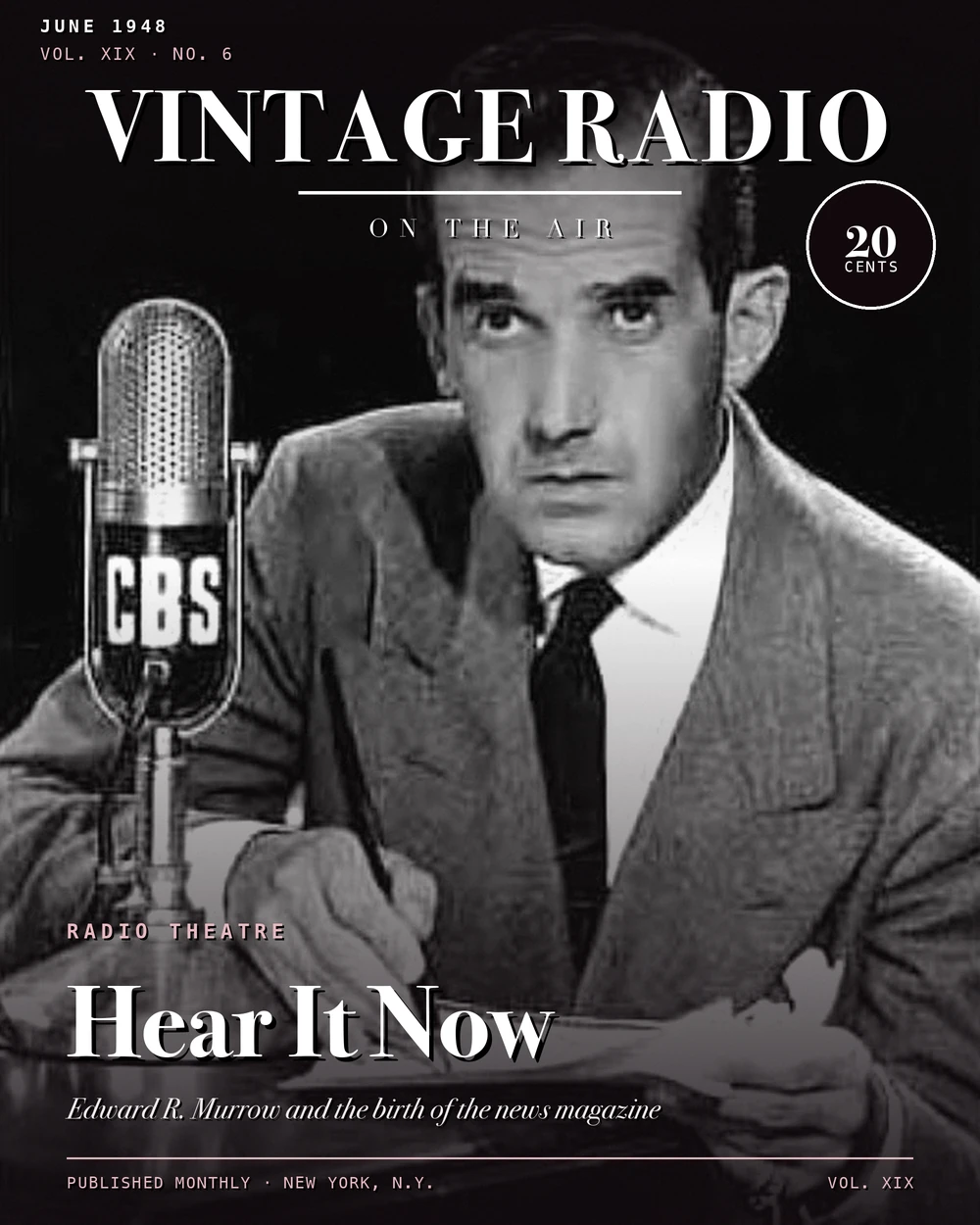
Hear It Now
How It Came to Be
Hear It Now arrived on CBS Radio on December 15, 1950, carrying a concept that Edward R. Murrow and producer Fred Friendly had been developing for two years through a far less likely medium: the record store. Their Columbia Records series I Can Hear It Now — five 78 rpm discs assembled from more than 500 hours of original broadcasts, covering the years 1933 to 1945 — had sold a quarter million copies in its first year and reached No. 3 on the U.S. albums chart. The Library of Congress later described it as "the recording industry's most successful spoken-word/non-musical album" of its era. That kind of commercial traction for a historical audio documentary was something no one had seen before, and it raised an obvious question: what would the same approach look like applied to the news of the current week?
CBS had been looking for a vehicle for Murrow, who was returning from Korea, and the network initially planned to call the new series Report to the Nation — that name was actually announced on a December 8, 1950 episode of Broadway Is My Beat as the show's replacement. Before premiere, CBS retitled it Hear It Now specifically to capitalize on the name recognition the record albums had built. The hour-long program went out on Friday evenings at 9 PM across 173 CBS affiliate stations.
Fred Friendly's road to this broadcast had started in 1937 at WEAN in Providence, Rhode Island, where he created a daily five-minute biography program called Footprints in the Sands of Time. His path ran through ABC, NBC, and a World War II stint in the U.S. Army Signal Corps — where he earned the Legion of Merit and the Soldier's Medal as a correspondent for CBI Roundup, the Army paper for the China-Burma-India Theater — before he joined CBS full-time in 1950. Edward Bliss's 1991 history of broadcast journalism described the Friendly-Murrow collaboration as "the most productive, most influential partnership in the whole history of broadcast journalism."
What the Show Actually Did
Hear It Now worked as a news magazine, covering the events of the preceding six days in the voices of the people who had made them. That sounds straightforward now, but in 1950 it was technically novel in a way that's easy to underestimate. Before this show, both CBS and NBC had banned recorded material — including interview "actualities" captured outside the studio — from their news broadcasts. Everything had to be live. Hear It Now used both transcription recordings and live microphones, drawing on newly available portable recording equipment that had been, as scholar Matthew C. Ehrlich put it in the Journal of Broadcasting & Electronic Media, "either nonexistent or extremely crude" only a few years earlier.
The Peabody Awards committee, which gave the show an honorable mention in the 1950 cycle, captured the novelty precisely in its citation: "a brilliant application of tape-recording to the purpose of the news summary, by which the listener is privileged to hear the news from the very individuals who made it." One critic described it at the time as "the biggest adventure in news gathering ever attempted." Time magazine's review, while generally positive, called some of the audio "fairly routine" — which at least confirms the show was being measured against serious journalistic standards rather than treated as a curiosity.
Each episode closed with a four-to-ten-minute segment Murrow called a "closeup," a focused look at a single person or story. The show's range was wide: post-election job seekers, Sugar Ray Robinson, correspondent David Schoenbrun reporting from Paris on the distance between a new runway hat and its $10.95 New York knockoff, and a segment called "Moonshine, USA" — described as an "oral document" — produced by reporter Joe Wershba and producer Ed Scott in the Blue Ridge Mountains. The reporter assignments stretched across subjects a modern news magazine would still recognize as a full editorial mix.
The Stories That Hit Hardest
No single broadcast generated more audience response than the piece Murrow's team built around what he described as the biography of a pint of blood. The segment followed one unit of blood from an American donor all the way to an operating table in Korea, where it helped save a wounded corporal. The broadcast prompted half a million blood donations across the country, according to research published in the Journal of Broadcasting & Electronic Media in 2007.
The show also covered the Kefauver Committee hearings on organized crime, with Episode 14 — aired March 16, 1951 — presenting excerpts of mobster Frank Costello testifying before the Senate. The April 13, 1951 episode turned to President Truman's relief of General Douglas MacArthur from command in the Far East, an announcement Truman had made just two days earlier. MacArthur also appeared as the subject of one of Murrow's "closeup" segments after his return to the United States. The show moved quickly to the news as it broke, which was exactly the point.
Ehrlich's scholarship characterized Murrow's editorial posture on the program as emphasizing "collective responsibility and reason" rather than outright opposition — a stance that would carry forward into See It Now and eventually sharpen into the confrontations that made that television program famous.
The Team Behind It
Murrow was the public face, but Hear It Now was built around several people doing distinct jobs. Fred Friendly wrote and produced. Red Barber handled sports commentary. Abe Burrows covered entertainment. Don Hollenbeck was the commentator on the press. Virgil Thomson, the composer and music critic, wrote the show's musical score. The range of those contributors — a sportswriter, a satirist, a press critic, a serious composer — reflects the ambition of the format. This wasn't a news bulletin read by a single voice; it was an assembled magazine with specialists reporting their own beats.
The pilot that preceded the series aired on November 9, 1950 — a broadcast titled "A Report to the Nation — The 1950 Election," produced by Murrow and Friendly for CBS Radio, as documented in Ralph Engelman's book Friendlyvision: Fred Friendly and the Rise and Fall of Television Journalism. By the time the series launched in December, the production method was already worked out.
Why It Lasted Only One Season
Hear It Now ran through June 15, 1951 — six months, roughly 26 episodes. The reason it ended was not that it failed. It was that Friendly could see television coming and wanted to take the same approach there. Murrow, according to his biographer Joseph E. Persico, "distrusted a medium that depended more on pictures than words," which is why the show had started on radio in the first place. He eventually relented.
See It Now premiered on CBS television on November 18, 1951 — five months after Hear It Now's finale. On that first television episode, Murrow told viewers: "This is an old team, trying to learn a new trade." See It Now ran on CBS until July 5, 1955, and is best remembered for Murrow's direct confrontation with Senator Joseph McCarthy over the tactics of congressional Communist-hunters. The 2005 film Good Night, and Good Luck drew on that chapter of the story.
Persico's assessment of where Hear It Now sat in the larger arc of broadcasting history was sharp: the show was, he wrote, "rather like building the best gas lamp at the turn of the century, when most people were wiring their homes for electricity." Ehrlich's phrase for it — "a little golden moment in radio news that did not last" — carries the same weight. The program was demonstrating what radio journalism could do technically and editorially just as the industry's center of gravity was shifting away from radio entirely.
What It Left Behind
The Library of Congress credits Hear It Now with helping create "the concept of the media news magazine." That's a significant claim for a program that lasted six months, but the lineage supports it. The I Can Hear It Now record albums established that documentary audio could reach a mass audience. The radio series proved the same approach could work week to week, covering current events as they happened. See It Now transferred both lessons to television, and Friendly carried the production sensibility forward through CBS Reports — including Harvest of Shame in 1960 — and eventually to the presidency of CBS News, which he held from March 1964 until his resignation in protest in February 1966, when CBS chose to air an I Love Lucy rerun rather than carry a live Senate Vietnam hearing. Friendly later held the Edward R. Murrow Professorship of Journalism at Columbia University and helped establish PBS.
At the time Hear It Now premiered, 94 percent of American households owned a radio — roughly 40 million homes — and the radio audience still exceeded the television audience by Nielsen's measurements. Television didn't surpass radio in audience size until around 1955. For that narrow window, Hear It Now was reaching the largest available broadcast audience with the most technically advanced approach to news the medium had ever managed.